
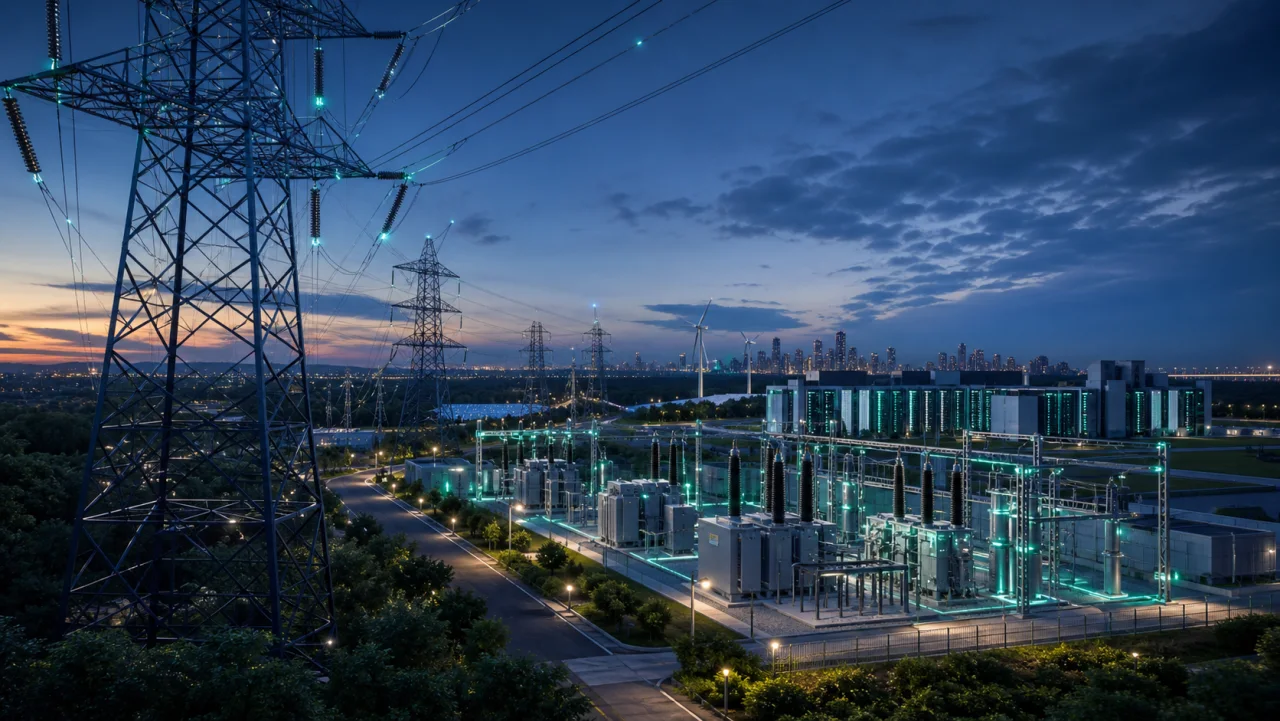
The power grid investment theme in 2026 is no longer limited to traditional utilities building transmission lines. Artificial intelligence data centers, advanced manufacturing, electric vehicles, building electrification, renewable energy integration, and the need to modernize aging U.S. transmission and distribution assets are driving investment across generation, substations, transmission, distribution, and grid digitalization.
But “power grid stocks” are not a sector with a unified business model. There are companies that make switchgear, transformers and distribution systems; there are companies that build transmission lines and substations; there are companies that provide smart meters, communications networks and grid analytics software; and there are companies that generate relatively stable returns from regulated utility capital expenditures.
These companies have very different growth rates, margins, capital requirements, valuation frameworks, and risk profiles. Investors should not simply ask which power grid stock has performed best. They should first determine:
- Where the company sits in the power grid value chain;
- Whether orders and backlog are converting into revenue;
- Whether margin improvement reflects structural gains or one-time project settlements;
- Whether the current valuation already assumes an overly optimistic power-demand scenario;
- Whether demand growth can translate into higher earnings per share and free cash flow.
Direct answer: Grid stocks worth studying in 2026 include Eaton (ETN), GE Vernova (GEV), Quanta Services (PWR), Hubbell (HUBB), Itron (ITRI), MYR Group (MYRG), NextEra Energy (NEE), and American Superconductor (AMSC). ETN, GEV and HUBB focus on electrical equipment and transmission and distribution hardware; PWR and MYRG provide grid engineering and construction services; ITRI provides smart meters, communication networks and grid edge software; NEE provides more robust grid exposure through regulated utilities and large energy infrastructure investments; AMSC is a riskier and smaller grid control and power quality technology company.
This is a research list, not a fixed ranking or a buy recommendation. The best choice depends on valuation, investment horizon, risk tolerance, income needs, and the part of the value chain an investor wants to own.
2026 Power Grid Stock Comparison Table
| Company | Ticker | Power Grid Role | Main 2026 Strength | Key Metric to Watch | Primary Risk | Best Fit |
|---|---|---|---|---|---|---|
| Eaton | ETN | Power distribution, switchgear, power management and data center electrical systems | Strong orders, backlog and electrical business growth, broad product coverage | Electrical Americas orders, backlog, margins, free cash flow | High valuations, M&A consolidation, data center order normalization | Investors who prefer high-quality industrial growth stocks |
| GE Vernova | GEV | Power generation equipment, transformers, HVDC, substation and grid software | Benefit from both power generation expansion and grid upgrades, high order visibility | Electrification orders, equipment backlog, adjusted EBITDA, cash conversion | Large project execution, cycle, policy and supply chain | Investors who prefer the growth of highly resilient energy infrastructure |
| Quanta Services | PWR | Transmission, distribution, substation and large load connection engineering | Engineering capabilities, skilled labor and large customer relationships pose barriers to entry | Electric segment backlog, RPO, margins, cash flow | Project execution, labor costs, weather and customer delays | Investors who prefer infrastructure services compounding |
| Hubbell | HUBB | Power transmission and distribution components, connectors, protection equipment and smart grid products | Indispensable products, stable replacement demand, strong pricing power | Utility Solutions organic growth, adjusted profit margin, orders | Industrial stock valuation premium, channel inventory, raw material costs | Investors who prefer quality industrial stocks |
| Itron | ITRI | Smart meters, communication networks, data analytics and grid edge software | Migrating from hardware to high-margin software and sustainable revenue | Outcomes revenue, adjusted gross margin, backlog, project deployment | Revenue recognition fluctuations, utility procurement cycles, project delays | Investors who prefer smart grid digitalization themes |
| MYR Group | MYRG | Power transmission and distribution and commercial electrical construction | Small market capitalization, direct participation in T&D projects, higher growth sensitivity | T&D revenue, backlog of orders, project gross margin, fixed price contract risks | Single project losses, low profit margins, customer and project fluctuations | Investors who can withstand the fluctuations of small and mid-cap engineering stocks |
| NextEra Energy | NEE | Regulated Utilities, Transmission and Distribution, Generation & Storage Investments | Large Capital Programs, Regulatory Asset Growth and Dividend Attributes | FPL CapEx, Regulatory Capital, Adjusted EPS, Financing Costs | Interest Rates, Regulatory Decisions, Capital Intensity and Project Financing | Investors Preferring Defensive Growth vs. Dividends |
| American Superconductor | AMSC | Grid control, power quality, transformers and superconducting systems | Small base growth, product portfolio expansion, data center and utility needs | Grid revenue, orders, 12-month backlog, cash flow | Small market cap, high volatility, customer concentration, M&A execution | Only suitable for small position investors who can tolerate high risk |
What Are Power Grid Stocks?
Grid stocks are publicly traded companies whose revenue, profits or asset growth are closely tied to investments in the infrastructure that transports electricity from generation to end users.
A complete electrical grid is more than just transmission lines. It usually includes:
- Generation Access: Connecting natural gas, nuclear, wind, solar and energy storage facilities to the grid.
- High-voltage power transmission: Transmit power over long distances through high-voltage AC or high-voltage DC lines.
- Substations and Transformers: Change voltage levels, and control and protect the flow of electricity.
- Distribution System: Delivers power from the regional grid to homes, factories, commercial buildings, and data centers.
- Protection and control equipment: including circuit breakers, relays, switchgear, insulation products and power quality systems.
- Smart Grid and Metering: Use smart meters, communication networks, sensors and software to monitor loads, faults and asset status.
- Engineering and Construction Services: Complete lines, substations, underground cables, grid-connected facilities and large-scale load access projects.
- Utility Capital Investment: Regulated utilities expand their asset base through capital expenditures and earn returns within the regulatory framework.
Therefore, grid stocks can be divided into at least four main business models:
- Equipment Manufacturer: Eaton, GE Vernova, Hubbell, AMSC;
- Engineering and construction service providers: Quanta Services, MYR Group;
- Smart grid technology provider: Itron;
- Regulated Utility and Energy Infrastructure Operator: NextEra Energy.
These four types of companies should not be valued using the same set of criteria. For example, equipment companies focus on orders, backlog, pricing, and manufacturing margins; construction companies focus on project portfolio, backlog, and execution; utility companies focus on regulatory capital, financing costs, and earnings per share growth; and smart grid companies focus on software revenue share, project deployment, and gross margin structure.
Why Power Grid Stocks Matter in 2026
1. U.S. electricity demand has emerged from secular stagnation
U.S. electricity consumption has been growing slowly for a long time, but data centers, advanced manufacturing and electrification are changing that trend. The U.S. Energy Information Administration pointed out in its 2026 outlook that U.S. electricity demand has grown at an average annual rate of about 2.1% over the past five years, and long-term demand is expected to continue to grow. Data center server power consumption is one of the important driving factors.
Higher electricity demand means not only more generation capacity, but also more transformers, switchgear, substations, transmission lines, distribution upgrades and grid control systems.
2. AI data centers turn “power availability” into a core bottleneck
Building a data center is no longer just a matter of acquiring land and servers. Large AI campuses may require hundreds of megawatts or even gigawatts of power capacity, and the construction period for power generation and transmission facilities is usually significantly longer than the data center building itself.
This spreads investment opportunities upstream from GPUs and servers to:
- High voltage transformer;
- switchgear and busbars;
- substation;
- Transmission lines;
- Grid access project;
- Power generation equipment and energy storage;
- Power monitoring and load management software.
However, investors should also avoid simply attributing all electrical equipment orders to AI. Industrial facilities, residential construction, renewable energy integration, extreme weather resilience and regular replacement cycles are equally important. Healthier companies typically have multiple sources of demand rather than relying solely on a single AI capex cycle.
3. Old infrastructure needs to be continuously replaced and reinforced
Grid investment does not entirely rely on new loads. A large number of U.S. transmission and distribution assets need to be replaced, and extreme weather, wildfires, hurricanes and freezing events are also driving utilities to increase investment in undergrounding, storm hardening, line reconstruction, automation and protective equipment.
This replacement need is typically more dispersed than a single new build project and may also be more ongoing. Hubbell, Eaton, Quanta Services and MYR Group can all benefit from utility budgets for long-term maintenance and upgrades.
4. Renewable energy and energy storage increase grid complexity
The geographical location and output characteristics of wind and solar energy are different from traditional thermal power. As more intermittent resources enter the grid, the power system needs to:
- New long-distance power transmission capabilities;
- Stronger voltage and frequency control;
- Energy storage and flexible generation;
- More refined load forecasting;
- Faster fault detection and isolation;
- Distributed energy management.
This not only increases the demand for lines and equipment, but also increases the potential value of smart grid and power quality companies such as Itron and AMSC.
5. Policy and planning mechanisms support long-term transmission investment
The Federal Energy Regulatory Commission’s Order No. 1920 requires transmission planning agencies to conduct long-term regional transmission planning for at least 20 years and improve cost allocation methods. The rule itself won’t automatically translate into company revenue, but it reflects regulators’ attempts to address insufficient long-term planning and the slow construction of cross-regional transmission.
Investors need to distinguish between “policy announcement” and “project start”. What really affects the company’s performance is project approval, financing completion, equipment ordering, project start, and revenue recognition, rather than title-level planning goals.
How Profits Flow Across the Power Grid Value Chain
The core of the grid theme is not that all players get the same rewards at the same time. Profits often depend on supply tightness, product differentiation, project risk and capital structure.
Equipment makers: Higher profit margins, but often more expensive valuations
Transformers, switchgear, circuit breakers, distribution systems and protection products have certification requirements, long-term customer relationships and high reliability thresholds. When supply is tight and lead times are long, equipment manufacturers may have stronger pricing power and order visibility.
But the risk for equipment stocks is that the market may be pricing in years of demand in advance. Once order growth slows, capacity expands too quickly, or data center projects are delayed, valuations may compress faster than fundamentals deteriorate.
Engineering Contractor: Order size is large, but execution determines profit
Transmission lines, substations and large load connections require skilled labor, project management and customer trust. Large contractors such as Quanta Services therefore have high barriers to entry.
However, construction revenue does not equal high-quality profits. Fixed-price contracts, labor shortages, weather, material costs and project changes can all impact gross margin. Investors should look at both backlog growth and cash flow, rather than just contract value.
Smart grid technology provider: long-term growth is good, but revenue recognition may not be smooth
Companies like Itron typically go through utility tendering, piloting, approvals, deployment and long-term service cycles. Large projects can bring significant backlog, but quarterly revenue can fluctuate due to changes in deployment timing.
The quality of the business model may improve when software, analytics and ongoing services revenue increases; but overall growth may still be unstable if hardware revenue declines too quickly or projects are delayed.
Regulated utilities: more stable growth, but highly dependent on capital costs
Utilities expand their regulated asset base through capital investments and earn earnings at regulatory-approved rates of return. Revenue visibility is typically higher with this model, but capital expenditures require significant debt and equity financing.
Rising interest rates, lower regulatory returns, cost overruns or rate disputes could all erode shareholder returns. Therefore, utility stocks are not a “low-risk risk-free asset,” but rather a regulated, capital-intensive, interest-rate-sensitive, long-term investment.
How We Selected the Best Power Grid Stocks for 2026
This page is not ranked based on short-term gains, but is filtered according to the following six dimensions:
1. Is the grid revenue exposure real?
The company must generate substantial revenue from equipment, software, construction, transmission and distribution assets or grid services. Just because a product might be used in data centers or the energy industry doesn’t make it a core grid stock.
2. Whether visibility is provided for orders and backlog
For equipment and engineering companies, orders and backlog can indicate future revenue potential. But investors should also check:
- Can the backlog of orders be cancelled?
- When it is expected to be converted into revenue;
- Whether the project profit rate is reasonable;
- Whether there is customer concentration;
- Whether significant working capital and capital expenditure are required.
3. Does the profit margin have quality?
Margin improvements could come from price increases, improved product mix, higher capacity utilization or higher software revenue, which are generally more sustainable. Conversely, project closings, one-time change orders and accounting estimate adjustments could push profit margins higher than normal in a single quarter.
4. Can the balance sheet support growth?
Funding is needed for equipment expansions, acquisitions, transmission projects and utility capital programs. Free cash flow, net debt, interest coverage, equity dilution and debt maturity structure are important.
5. Is execution deviation allowed in valuation?
A high-quality company is not necessarily a high-quality buy. If the market has assumed continued high order growth, continued profit margin expansion, and no project delays, then even if the company grows normally, stock price returns may be limited.
6. Whether the risk matches the investor
ETN, HUBB and NEE are generally more suitable for investors pursuing quality or stability; GEV, PWR and ITRI have more obvious growth and revaluation attributes; MYRG and AMSC require higher volatility tolerance.
Eaton (ETN): Quality leader in grid equipment and electrification theme
Why Eaton Stands Out
Eaton is one of the companies with the broadest coverage of the grid and electrification theme. It provides power distribution, switchgear, circuit breakers, power quality, backup power, busbar and data center electrical systems to customers across the utility, industrial, commercial building, data center and residential markets.
Compared with companies that only rely on a single transmission equipment, Eaton’s advantage is that it can profit from multiple links of “power enters the facility from the grid and is then distributed to the final load.” Data centers, grid upgrades, manufacturing reshoring and commercial building electrification are all likely sources of demand.
Evidence from 2026 Results
Eaton’s sales in the first quarter of 2026 reached US$7.5 billion, a year-on-year increase of 17%, of which organic growth was 10%. Electrical Americas sales reached US$3.6 billion, a year-on-year increase of 20%; the business’s rolling orders increased by 42% in the past 12 months, mainly driven by data center demand. The company’s electrical business backlog increased by 48% year-on-year, and the midpoint of its 2026 organic growth guidance was raised from 8% to 10%.
These data illustrate that demand is not only present in the market narrative, but also in orders, sales and backlog. But investors still need to confirm whether order growth can continue to be converted into cash flow, because the company is also expanding production and making large acquisitions.
Eaton’s core investment logic
- The electrical equipment portfolio is complete, and customer switching costs and certification thresholds are high;
- The demand for data centers and utilities is growing at the same time, and revenue sources are more diversified;
- Higher profit margins and cash flow capabilities support reinvestment;
- Add thermal management and critical power systems capabilities through capacity expansion and acquisitions;
- Business quality is generally higher than typical cyclical industrial companies.
What to Watch
- Whether Electrical Americas’ order growth remains high;
- Whether the growth in backlog is accompanied by growth in revenue and free cash flow;
- Whether capacity expansion eases the delivery cycle rather than causing future excess;
- Whether large-scale mergers and acquisitions dilute profit margins or increase liabilities;
- Whether data center orders are excessively concentrated in a few very large customers.
Main Risks
Eaton’s biggest risk isn’t necessarily a loss of demand, but an overvaluation. When the market simultaneously expects high organic growth, strong pricing, and margin expansion, any slowdown in orders, M&A integration costs, or lower-than-expected margins could trigger valuation compression.
Best suited for: Long-term growth investors who want multiple exposure to grid, data center and industrial electrification and are willing to pay a premium for business quality.
GE Vernova (GEV): Beneficiary of the entire chain from power generation to high-voltage transmission
Why GE Vernova Stands Out
GE Vernova is unique in that it not only sells grid equipment but also provides gas turbines, wind power, energy storage, transformers, HVDC, FACTS, grid software and power conversion systems.
When AI data centers and advanced manufacturing increase power demand, the power system may require additional generation and transmission capacity at the same time. GE Vernova therefore covers both ends of “generating more electricity” and “delivering electricity to where it is needed”.
Its Electrification business includes Grid Solutions, Power Conversion, energy storage and grid software, and is directly involved in transformers, substations, high-voltage direct current transmission and grid stability projects.
Evidence from 2026 Results
In the first quarter of 2026, GE Vernova’s orders reached US$18.3 billion, an organic growth of 71%; the backlog of orders increased by US$13 billion from the previous quarter. Revenue was US$9.3 billion, a year-on-year increase of 16% and an organic growth of 7%, mainly driven by the Electrification and Power equipment businesses. Adjusted EBITDA was approximately US$900 million, with a profit margin of 9.6%, a year-on-year increase of 390 basis points.
Order growth and backlog expansion provide higher visibility, but the company’s business includes cyclical, project and merger and acquisition factors, and investors should not directly use single-quarter net profit to judge sustained profitability.
GE Vernova’s core investment logic
- Possess scarce capabilities such as high-voltage transformers, HVDC and grid stabilization technology;
- Simultaneously benefit from natural gas power generation capacity expansion, renewable energy grid integration and transmission upgrades;
- Equipment backlog likely to support multi-year revenue;
- Scale and global customer base constitute strong barriers to competition;
- There is still room for improvement in Electrification profit margins.
What to Watch
- The growth and delivery pace of Electrification’s backlog of orders;
- Whether the equipment project price covers raw materials and labor costs;
- Whether the adjusted EBITDA profit margin can continue to expand;
- Whether accounting gains and operating profits from large acquisitions are correctly distinguished;
- Whether the expansion of transformers and high-voltage equipment is completed as planned.
Main Risks
GEV assumes the execution risk of large equipment projects. Project delays, raw material costs, warranty expenses, supply chain and customer financing can all impact profits. In addition, if the stock price has already factored in multi-year order growth, short-term order normalization may also cause greater volatility.
Best suited for: Growth investors who want integrated exposure to power generation, grid equipment and energy infrastructure, and can withstand higher valuations and project volatility.
Quanta Services (PWR): Engineering and skilled labor platform needed for grid expansion
Why Quanta Services Stands Out
After the power grid equipment is produced, the company still needs to complete the construction of transmission lines, distribution networks, substations, underground cables, large load access and communication infrastructure. Quanta Services is one of North America’s largest specialty infrastructure contractors.
The company’s competitive advantages are not just equipment or patents, but include skilled labor, project management, customer relationships, safety records and the ability to execute across geographies. In an environment where grid investment is growing rapidly and professional labor is in short supply, this capability may be more valuable than pure construction capacity.
Evidence from 2026 Results
Quanta’s revenue in the first quarter of 2026 was US$7.87 billion, up from US$6.23 billion in the same period last year; adjusted earnings per share were US$2.68, compared with US$1.78 in the same period last year. The total order backlog reached a record $48.5 billion, with remaining performance obligations of $26.2 billion. The company’s power business backlog is approximately US$40.1 billion, and it has raised a number of financial expectations for 2026.
Backlog provides revenue visibility, but the key question for construction companies is always whether the order can be filled at a reasonable profit margin and cash return.
Quanta’s core investment logic
- Cross-growth among power grid, power generation and large load markets;
- Skilled labor and large customer relationships create barriers to entry;
- Business covers power transmission, distribution, substations and underground infrastructure;
- Scale facilitates procurement, project scheduling and cross-regional construction;
- Large backlog supports future revenue.
What to Watch
- Electric Power business backlog and revenue conversion;
- Whether the adjusted EBITDA profit margin is stable;
- Whether operating cash flow and net profit grow simultaneously;
- Whether there are cost overruns in fixed-price contracts and large-scale projects;
- Whether the growth brought about by the acquisition increases the value per share.
Main Risks
Quanta faces labor shortages, weather, customer delays, project permitting and cost estimate risks. The backlog is large, but if project profit margins decline or capital recovery slows down, revenue growth may not necessarily equal shareholder return growth.
Best suited for: Infrastructure investors who believe that North American power grid construction cycles are multi-year and want to gain thematic exposure through engineering services rather than single equipment.
Hubbell (HUBB): A quality company that provides key components and replacement needs for power transmission and distribution
Why Hubbell Stands Out
Hubbell’s Utility Solutions business provides power transmission and distribution connectors, insulation products, protection equipment, smart meters, communications systems and control components. Many of the products don’t necessarily have a high unit price, but are essential for reliable operation of the grid and need to meet the utility’s technical and safety standards.
The advantage of this type of business is that the sources of demand are dispersed. In addition to large new transmission projects, there will be continued demand from routine maintenance, storm repair, equipment replacement, distribution expansion and smart grid upgrades.
Evidence from 2026 Results
Hubbell’s net sales in the first quarter of 2026 increased by 11% year-on-year, with organic growth of 8.2%; adjusted earnings per share were US$3.93, a year-on-year increase of 16%; adjusted operating profit margin was 19.8%, a year-on-year increase of 110 basis points.
Utility Solutions’ first quarter sales were approximately US$949 million, a year-on-year increase of 11%; the segment’s operating profit was approximately US$175.1 million, a year-on-year increase of 16.1%. The data suggests utility-related businesses are returning to growth while maintaining strong margins.
Hubbell’s core investment logic
- Transmission and distribution components require replacement and maintenance attributes;
- Certification, reliability and channel relationships constitute barriers to competition;
- The product portfolio is relatively dispersed and does not rely on a single large-scale project;
- Possess pricing power and high industrial profit margin;
- Can benefit from grid reinforcement, storm repair and distribution expansion.
What to Watch
- Utility Solutions organic revenue growth;
- Whether channel inventory is consistent with terminal demand;
- Whether the adjusted operating profit margin is sustainable;
- Whether the acquisition adds high-quality products rather than just revenue;
- Whether utility capital budgets are affected by interest rate or regulatory delays.
Main Risks
Hubbell typically trades at a premium to quality industrial stocks. If growth returns to mid-single digits, while valuations still assume long-term double-digit growth, the stock price could come under pressure. In addition, channel destocking and changes in raw material prices will cause quarterly fluctuations.
Best suited for: Quality-oriented investors who prefer stable product demand, higher profit margins and long-term compounding, rather than pursuing the strongest thematic upside.
Itron (ITRI): Digital target for smart grid, metering and grid edge data
Why Itron Stands Out
Traditional grid upgrades not only require more copper, transformers and lines, but also better data. Utilities must know where power is being used, when failures occur, which equipment is about to fail, and how distributed energy resources affect loads.
Itron provides smart meters, communications networks, equipment management, data analytics and operations software. The long-term investment rationale is to shift from hardware suppliers to smart grid platforms that include ongoing software, services and analytics revenue.
Evidence from 2026 Results
Itron’s revenue in the first quarter of 2026 was US$587 million, a year-on-year decrease of 3%, mainly affected by project deployment time and product portfolio optimization. Despite the decline in revenue, the company’s adjusted EBITDA increased to $92 million, a year-on-year increase of 5%; free cash flow increased to $79 million.
More importantly, Outcomes business revenue increased by 22% year-on-year, and the adjusted gross margin increased by 490 basis points to 40.7%. The order backlog at the end of the quarter was $4.4 billion.
This set of data reflects Itron’s dual characteristics: project-based revenue may fluctuate, but the increased proportion of high-margin software and ongoing services has the opportunity to improve the quality of the business model.
Itron’s core investment logic
- Utility digitalization and smart metering are long-term structural needs;
- Large backlog provides deployment visibility;
- Outcomes and software service revenue are growing faster than hardware;
- Smart grid data can help utilities improve reliability and reduce losses;
- Grid edge intelligence and distributed energy management increase long-term market space.
What should we focus on?1. Outcomes and sustainable revenue growth;
- Whether the Networked Solutions project deployment is restored;
- Backlog order conversion cycle;
- Whether the improvement in gross margin comes from the structural product portfolio rather than the timing of short-term projects;
- Post-acquisition integration costs and debt management.
Main Risks
Utility procurement cycles are long, and projects can be delayed by regulatory, budgetary or technology integration issues. Changes in the timing of revenue recognition will cause quarterly fluctuations. If software growth cannot offset slowing hardware and network deployment, valuations may come under pressure.
Best suited for: Growth investors looking to invest in smart grid, softwareization and grid data rather than just holding traditional equipment companies.
MYR Group (MYRG): A more straightforward but more volatile power transmission and distribution construction stock
Why MYR Group Stands Out
MYR Group is a specialist electrical contractor that is significantly smaller than Quanta Services. Its Transmission and Distribution business is involved in transmission lines, distribution systems, substations and related power infrastructure projects.
A small market capitalization means that when orders, utilization and profit margins improve simultaneously, earnings per share elasticity may be higher; but when cost issues arise on a single project, the impact on overall performance will also be greater.
Evidence from 2026 Results
MYR Group’s revenue in the first quarter of 2026 reached US$1 billion, a year-on-year increase of US$166.8 million. T&D business revenue was US$541 million, a year-on-year increase of US$79.2 million. Comprehensive gross margin increased to 13.4% from 11.6% in the same period last year, net profit reached US$46.8 million, and diluted earnings per share were US$2.99.
The backlog of orders at the end of the quarter reached a record high of US$2.84 billion, of which T&D backlog was approximately US$980.7 million.
However, the company said profit margins in the quarter were affected in part by better productivity, favorable change orders and project settlements. Investors should not simply make the single-quarter gross margin of 13.4% permanent.
MYR Group’s core investment logic
- Direct exposure to North American transmission and distribution construction demand;
- Small market capitalization brings higher operating leverage;
- T&D revenue growth shows improving demand;
- Balance sheet is relatively flexible;
- Can be used as a supplementary research target in addition to large-scale project leaders.
What to Watch
- Whether the growth of T&D backlog continues;
- How much of the gross margin comes from repeatable execution improvements;
- Proportion of fixed-price contracts and cost overruns;
- Whether operating cash flow supports profit growth;
- Whether a single project or customer had a disproportionate impact on quarterly results.
Main Risks
The engineering contracting business has low profit margins, and a single wrong cost estimate may significantly affect profits. MYRG is smaller, and stock price liquidity and volatility are generally higher than those of larger industrial companies.
Best suited for: Investors who can analyze the risks of engineering projects and accept larger fluctuations in small and mid-cap stocks.
NextEra Energy (NEE): Gaining robust grid exposure through regulatory capital investments
Why NextEra Energy Stands Out
NextEra Energy owns Florida Power & Light (FPL) and large-scale renewable energy, energy storage and energy infrastructure development businesses. Unlike equipment and construction companies, NEE’s main investment logic comes from long-term capital investment, regulatory asset growth, contract energy projects and dividends.
FPL serves Florida, which has a rapidly growing population and electricity demand, and continues to invest in transmission and distribution reinforcement, power generation, solar, energy storage and reliability projects.
Evidence from 2026 Results
NextEra Energy’s adjusted earnings per share in the first quarter of 2026 was $1.09, a year-over-year increase of 10%. FPL’s capital expenditure in the current quarter was approximately US$3.2 billion, and it is expected to invest US$12 billion to US$13 billion in 2026. Regulatory capital will increase by approximately 8.8% year-on-year.
The company also said FPL expects to invest approximately $90 billion to $100 billion through 2032 to support Florida growth and power infrastructure needs.
NextEra’s core investment logic
- Regulated utility assets provide higher revenue visibility;
- Substantial capital plan supports regulatory capital and earnings per share growth;
- Power transmission and distribution, power generation, solar energy, energy storage and large load demand create diverse opportunities;
- Has dividend and defensive attributes;
- Strong scale, financing capabilities and development experience.
What to Watch
- Whether FPL’s capital expenditures obtain reasonable regulatory returns;
- Adjusted earnings per share and dividend growth;
- Changes in interest rates and financing costs;
- Whether capital requirements for new projects will lead to equity dilution;
- Storm cost, insurance and regulatory recovery schedule.
Main Risks
NEEs are capital-intensive companies. Higher interest rates raise financing costs and make utility stocks less attractive relative to bonds. Regulatory returns, rate cases, project delays and large-scale capital programs can all impact per-share value.
Best suited for: Investors who want exposure to more robust power demand and grid capital expenditures while focusing on dividends and long-term visible growth.
American Superconductor (AMSC): High-Risk Small Grid Technology and Power Quality Company
Why AMSC Stands Out
American Superconductor provides grid control, power quality, reactive power compensation, transformers, industrial power systems and superconducting related technologies. The company is much smaller than Eaton and GE Vernova, so it shouldn’t be considered a core holding at the same level.
Its appeal lies in its smaller revenue base, product portfolio expansion and demand for power quality and grid stability from utilities, industry and data centers. If orders continue to grow, smaller companies may gain higher operating leverage.
Evidence from 2026 Results
For the 2025 fiscal year ending March 31, 2026, AMSC’s revenue was US$299.2 million, up from US$222.8 million in the previous fiscal year, a year-on-year increase of approximately 34%, of which the company disclosed organic growth of approximately 25%. Revenue in the fourth fiscal quarter was US$86.4 million, a year-on-year increase of approximately 30%.
The company’s 12-month order backlog increased nearly 40% year-on-year to about $280 million, and it said orders were driven by traditional energy, utility and data center demand.
However, GAAP net profit in fiscal year 2025 was affected by a large non-cash tax benefit brought about by the reversal of deferred tax asset valuation provisions. Therefore, investors should pay more attention to operating profit, orders, cash flow and normalized earnings per share, rather than directly using the current year’s GAAP net profit valuation.
AMSC’s core investment logic
- The business scale is small, and revenue and order growth may bring high elasticity;
- Grid products cover grid stability, power quality and transformers;
- Acquisitions expanded traditional power equipment and regional coverage;
- Improved power quality requirements for data centers and large industrial loads;
- Improved cash position, providing some support for expansion.
What to Watch
- Organic revenue and new orders from the Grid business;
- Sustainability of 12-month order backlog;
- Profit margin and integration of acquired businesses;
- Normalized operating profit and free cash flow;
- Customer concentration and order timing.
Main Risks
AMSC is a highly volatile small-cap stock. The business scale is small, orders may be concentrated, mergers and acquisitions integration is complex, and the stock price is easily affected by a single contract and market sentiment. GAAP profits due to tax benefits can also mislead valuations.
Best suited for: Only suitable for high-risk investors who understand small-cap stocks, can withstand large drawdowns, and are willing to control their positions.
Which power grid stock is most worth researching?
No one stock is best across all dimensions. A more reasonable classification is as follows:
The most balanced quality growth: Eaton
Eaton has exposure to both grid, data center and industrial electrification, with high profit margins and order quality. The main problem is that valuations usually aren’t cheap.
The strongest power generation and transmission equipment flexibility: GE Vernova
GEV covers both power generation equipment and high-voltage power grids, and has strong demand visibility, but project execution and valuation fluctuations are also higher.
The most direct large-scale power grid construction service: Quanta Services
PWR participates in power grid construction through skilled labor and project platforms, and has a large backlog of orders. Investors need to watch margins and cash conversion closely.
The most stable key parts company: Hubbell
HUBB has more diversified products and replacement needs, suitable for investors who prefer quality compounders, but thematic elasticity is generally lower than GEV.
Clearest exposure to smart grid software and data: Itron
ITRI is not a traditional high-voltage equipment manufacturer, but a smart metering, communication and data platform company. Its investment value depends on whether high gross profit sustained income continues to expand.
More flexible small and medium-sized cap construction targets: MYR Group
MYRG may show strong earnings sensitivity when T&D projects improve, but the risk of a single project is significantly higher than PWR.
More defensive utility capex exposure: NextEra Energy
NEE’s growth relies more on regulatory capital and long-term projects, and its volatility is generally lower than that of small-cap equipment stocks, but its interest rate sensitivity is higher.
High Risk Small Cap Technical Target: AMSC
AMSC may benefit from grid stability and power quality needs, but should not be viewed in the same breath as large core industrial stocks.
How to Value Power Grid Stocks
Equipment Companies: Comparing Growth, Margins and Valuation Premiums
ETN, GEV and HUBB can be compared using forward P/E ratio, EV/EBITDA, free cash flow yield and return on invested capital.
Investors should ask:
- How much revenue growth does the current valuation assume over the next few years?
- How much further can profit margins expand?
- Is order growth fully reflected in the stock price?
- Will capacity expansion increase returns, or cause depreciation and cost increases?
A simple valuation idea is to tie expected earnings per share growth to the price-to-earnings ratio. For example, a company that expects long-term earnings per share growth of 10% but trades at 40 times forward earnings would need very stable growth and low execution risk to support the valuation.
Engineering Firms: Don’t Just Look at Revenue and Backlog
PWR and MYRG should be compared simultaneously:
- Growth of backlog of orders;
- Gross profit margin and EBITDA profit margin;
- Operating cash flow conversion;
- project type;
- Fixed price contract risk;
- Acquisitions and Debt.
Backlog Coverage can be used as an auxiliary indicator:
Backlog coverage ratio = Ending backlog ÷ Revenue in the last 12 months
Higher coverage generally means better revenue visibility, but it doesn’t necessarily mean higher profits. A backlog of low-quality projects can also lead to losses.
Smart grid companies: focus on softwareization and sustainable income
ITRI’s valuation should be based on a combination of revenue growth, adjusted gross margin, percentage of continuing revenue, free cash flow and backlog conversion. If the proportion of software and services revenue increases, the company may obtain a higher valuation; but if overall revenue stagnates for a long time, a simple increase in gross margin will not be enough to support a high multiple.
Utilities: Focus on regulatory capital, financing costs and dividends
Utility companies such as NEE are better suited to use:
- Adjusted earnings per share growth;
- Regulatory capital growth;
- Dividend yield and dividend growth;
- cost of debt;
- credit rating; -Capital expenditure and financing requirements.
Regulated capital growth does not automatically equal earnings per share growth. If a capital program requires the issuance of a large number of shares, shareholder value per share may be diluted.
Small Cap Technology Companies: Normalize Profits First
AMSC’s GAAP earnings may be affected by taxes, mergers and acquisitions and one-time items. Investors should first exclude non-cash tax gains and other unusual items before evaluating operating profit, cash flow and orders.
Five Financial Metrics That Matter Most
1. Organic revenue growth
Organic growth excludes mergers and acquisitions and exchange rate effects and better reflects core business needs. Equipment company acquisitions can significantly increase reported revenue, so it’s important to look beyond total growth.
2. Order and Book-to-Bill
Book-to-Bill = New Order ÷ Current Revenue
If the ratio continues to be higher than 1, it usually means that the backlog of orders is growing; if it is lower than 1 for a long time, future revenue growth may slow down. However, order definitions and cancelability terms vary from company to company and cannot be compared mechanically.
3. Backlog of orders and their profit margins
Backlog amount is important, but more importantly:
- Can it be transformed;
- when to convert;
- What is the profit margin;
- Whether a large upfront payment or working capital is required;
- Whether the customer has the right to postpone or cancel.
4. Incremental profit margin
Incremental profit margin = increase in operating profit ÷ increase in revenue
If revenue is growing rapidly but incremental margins are low, it could be a sign that raw materials, labor, expansion, and project costs are eating up the growth. Conversely, higher incremental margins typically reflect improvements in pricing, product mix, or capacity utilization.
5. Free Cash Flow Conversion
Free cash flow conversion rate = free cash flow ÷ net profit
Engineering and equipment companies need inventory, accounts receivable, and capacity investments. If net profit growth cannot be converted into cash in the long term, investors should check working capital, project accounts and capital expenditures.
Key Catalysts for Grid Stocks in 2026
Utility capital expenditures continue to increase
Equipment and engineering companies will see enhanced order visibility as large utilities increase transmission and distribution, storm hardening and large load connection budgets.
Data center power projects move from planning to procurement and construction
The market often trades data center power topics ahead of time. Really valuable confirmation signals include:
- Orders for transformers and switchgear;
- Substation contract;
- Construction of power transmission and grid connection projects begins;
- Prepayment for equipment;
- Utility capital plan increases;
- The company’s revenue and cash flow are growing in tandem.
The supply of transformers and high-voltage equipment continues to be tight
If long lead times and tight supply persist, equipment vendors with manufacturing capabilities and customer certification may retain pricing power. However, if production is expanded too quickly, the supply and demand relationship may reverse in the future.
Grid digitalization and advanced metering deployment resume
Catalysts for companies like Itron will come from large-scale smart meter and communications projects entering the deployment phase, as well as software, analytics and ongoing revenue growth.
Interest rates fall
Lower interest rates could lower the cost of financing utilities and large projects, and could also increase the relative valuation investors place on utility stocks. However, interest rate cuts are usually related to the economic environment and cannot be viewed independently.
Profit expectations continue to be revised upwards
The strongest fundamental confirmation for a theme stock is usually not a single piece of news, but the simultaneous occurrence of order growth, revenue growth, margin expansion, free cash flow improvement, and management guidance upgrades.
Main Risks for Power Grid Stocks
1. Valuations already reflect years of high growth
High-quality companies such as ETN, GEV, PWR and HUBB may receive significant valuation premiums. If future growth is only “good” rather than “beating expectations,” the stock price could still fall.
2. Data center projects are double counted
Multiple developers may announce large campuses at the same time, but ultimately not all projects will come to fruition due to constraints on power, land, financing and customer demand. Investors should avoid viewing all announced capacity as firm demand.
3. Equipment expansion will cause excess supply in the future
The current tight supply is pushing manufacturers to expand production. If demand grows less than expected, lead times and prices could fall back, and profit margins could normalize.
4. Project cost overruns
Fixed-price contracts, weather, labor, permitting and material changes can all make a construction project lose money. The larger the backlog, the more important project risk management becomes.
5. Interest rate and financing risks
Utilities and large infrastructure projects require significant financing. High interest rates can delay projects, increase capital costs and depress valuations.
6. Regulation and Cost Allocation Disputes
Transmission construction involves multiple states, regulatory agencies and customer groups. Whether a project is approved, who bears the cost, and what rate of return is allowed will all affect the return on investment.
7. Supply Chain and Critical Materials
Transformers, electrical steel, copper, electronic components and skilled labor can become bottlenecks. Raw material prices and tariffs also affect costs.
8. Double effects of extreme weather
Storms and wildfires increase the need for repairs and reinforcements, but can also cause utility losses, insurance costs and regulatory risks. For construction companies, emergency repair revenue may increase, but project scheduling and safety risks also rise.
9. Technological changes and efficiency improvements
More efficient AI chips, on-site power generation, microgrids and energy storage may change the position of grid investment. Efficiency does not necessarily reduce aggregate demand, but it may change which firms benefit most.
Power Grid Stocks Compared with Other Investment Themes
Grid Stocks vs Utility Stocks
Utilities own and operate regulated assets and generate revenue from the sale of electricity and allowable returns; grid equipment and engineering companies sell products and services to utilities.
As a result, ETN, GEV and PWR may benefit from capital expenditures by multiple utility customers, while NEE relies primarily on its own asset investment, regulation and financing.
Grid Stocks vs Data Center Stocks
Data center stocks mainly cover facilities, computer rooms, power and cooling systems, networks and operators. Power grid stocks focus on power generation access, power transmission, power transformation, power distribution and power grid management upstream of data centers.
You can continue reading: Data center stocks worth watching in 2026.
Power Grid Stocks vs AI Infrastructure Stocks
AI infrastructure has a wider scope, including chips, servers, cloud platforms, networks, data centers, power and cooling. Grid stocks are just the upstream energy infrastructure layer of that.
You can continue reading: AI Infrastructure Stocks Worth Watching in 2026.
Power grid stocks vs AI chip stocks
AI chip companies mainly gain revenue through GPU, ASIC, HBM, advanced processes and semiconductor equipment; power grid companies solve the physical energy constraints of AI computing through power generation, transmission, distribution and power management.You can continue reading: AI chip stocks worth paying attention to in 2026.
Grid Stocks vs Nuclear Energy Stocks
Nuclear energy stocks focus on nuclear power plants, uranium, nuclear fuel and reactor technology; power grid stocks are responsible for connecting and delivering electricity, including nuclear power, to load centers.
You can continue reading: Nuclear Energy Stocks to Watch in 2026.
Choosing Power Grid Stocks by Investor Profile
Prefer quality growth
You can focus on Eaton, Hubbell and Quanta Services. These companies have strong customer relationships, execution capabilities and profit quality in their respective segments, but valuation discipline is important.
Prefer high growth and high elasticity
You can focus on GE Vernova and Itron. GEV benefits from the power generation and high-voltage grid equipment cycles, while ITRI provides smart grid digital exposure.
Prefer dividends and relative stability
You can focus on NextEra Energy. However, dividend investors still need to analyze interest rate, financing and regulatory risks, and not just look at the dividend yield.
Prefer small and mid-cap opportunities
You can research MYR Group and AMSC, but you should use smaller positions, higher safety margins, and continuously check projects, orders, and cash flow.
Want to diversify single company risks
Investors can also research industrial, infrastructure or utility ETFs, but will need to check holdings. Many so-called “grid ETFs” may hold large holdings of traditional utility, clean energy or integrated industrial companies and do not amount to pure grid equipment portfolios.
Grid Stock Investment Checklist
Before buying any power grid stock, answer at least the following questions:
- What specific products or services does the company sell? -What proportion of power grid-related income accounts for this?
- Will growth come from organic demand or M&A?
- Can the order be cancelled? How long is it expected to take to convert?
- Are project margins on the backlog healthy?
- Does the company need large-scale expansion or financing?
- Does profit growth translate into free cash flow?
- Are customers concentrated among a few utilities or data center developers?
- How much long-term growth does current valuation imply?
- How will rising interest rates affect the company?
- Which specific indicator will prove that the investment logic fails?
- If the stock price drops 30%, are the fundamentals still sufficient to support holding?
What Would Break the Grid Investment Thesis?
Long-term demand for the grid may still exist, but the following signals weaken the investment logic in the short to medium term:
- Utilities cutting or delaying capital programs; -Cancellation of large-scale data center load projects;
- Order growth is significantly lower than revenue, and Book-to-Bill is below 1 for a long time;
- Backlog grows but margins and cash flow decline;
- Rapidly shortening equipment delivery cycles accompanied by price pressure;
- The engineering company experienced continuous project impairment;
- Utility financing costs rise and regulatory returns fail to compensate;
- Companies maintain growth by issuing large amounts of stock;
- Management continues to adjust non-GAAP measures to cover up operating problems;
- Earnings forecasts are downgraded, while valuations remain at historically high levels.
Investors should distinguish between the two different propositions “the long-term grid requires more investment” and “the current stock price is attractive.” Industry demand may be right, but the buying price may still be wrong.
Bottom Line
The power grid is the physical infrastructure on which AI, manufacturing, electrification, and energy transition depend. Investment opportunities in 2026 have expanded beyond traditional utilities to include transformers, switchgear, high-voltage transmission, smart grid software, engineering and construction, and power quality systems.
Eaton provides the most balanced electrification and quality growth exposure; GE Vernova covers power generation and high-voltage grid equipment and is more resilient; Quanta Services is a large-scale grid engineering and skilled labor platform; Hubbell has stable transmission and distribution parts and replacement needs; Itron represents the data and software layer of smart grids; MYR Group provides higher volatility small and mid-cap construction exposure; NextEra Energy provides relatively stable growth through regulatory capital and energy infrastructure investment; AMSC is a high-risk small-cap grid technology play.
Long-term demand growth does not mean that all underlying stocks are worth buying at any price. What really matters is the company’s ability to convert grid capex into sustainable revenue, margins, free cash flow and per-share value, while current valuations still leave a margin of safety for project delays, order normalization and policy changes.
Primary Sources
- U.S. Energy Information Administration: Annual Energy Outlook 2026
- U.S. Energy Information Administration: U.S. Electricity Demand Outlook 2026
- U.S. Department of Energy: Speed to Power Initiative
- NERC: 2025 Long-Term Reliability Assessment
- FERC: Order No. 1920 Long-term Transmission Planning Description
- Eaton: First Quarter 2026 Financial Results
- GE Vernova: First Quarter 2026 Financial Results
- Quanta Services: First Quarter 2026 Financial Results
- Hubbell: First Quarter 2026 Financial Results
- Hubbell: First Quarter 2026 Form 10-Q
- Itron: First Quarter 2026 Financial Results
- MYR Group: First Quarter 2026 Financial Results
- NextEra Energy: First Quarter 2026 Financial Results
- AMSC: Fiscal Year 2025 and Fourth Quarter Financial Results
Related SnowballHare Research
- Best Data Center Stocks of 2026
- Best AI Infrastructure Stocks of 2026
- Best AI Chip Stocks of 2026
- Best Semiconductor Equipment Stocks of 2026
Editorial Note
SnowballHare provides investment education and research content with source links. This article compares the company’s business model, industrial chain position, operating evidence, valuation methods and risks, and does not provide personalized investment advice, target prices or buying and selling recommendations. Company results, guidance, valuations, dividends and industry conditions may change after the date this article was updated. Before making decisions, investors should consult the company’s latest financial reports, SEC documents and investor information, and make independent judgments based on their own investment objectives, time period and risk tolerance.
Common Questions
What are the power grid stocks worth watching in 2026?
Grid stocks worth studying in 2026 include Eaton, GE Vernova, Quanta Services, Hubbell, Itron, MYR Group, NextEra Energy and American Superconductor. They cover electrical equipment, high-voltage transmission, engineering construction, transmission and distribution components, smart grid software, regulated utilities and power quality technology respectively.
Which stock is the purest power grid equipment stock?
GE Vernova's Electrification business and Hubbell's Utility Solutions have more direct exposure to power transmission and distribution equipment. Eaton also has an important power grid business, but the company also covers data centers, industrial, aviation and other markets, so it is more diversified.
Which power grid stock is best for long-term investors?
Long-term investors generally focus more on Eaton, Hubbell, Quanta Services and NextEra Energy because these companies have more mature businesses and longer demand cycles. But whether it's a good buy still depends on valuation and investor risk appetite.
Why are AI data centers driving power grid stocks?
AI data centers increase large-scale, continuous and high-density power requirements. To supply power to the data center, new generation capacity, transformers, substations, transmission lines, distribution equipment, backup power and grid connection works may be required.
Is Eaton a power grid stock or a data center stock?
It's both. Eaton provides utility and industrial power distribution equipment, as well as power management, switchgear and thermal management systems within data centers. As such, it is a cross-section of grid and data center power topics.
Is GE Vernova a pure power grid stock?
no. GE Vernova also owns Power, Electrification and Wind businesses. Its grid exposure comes primarily from Electrification, including Grid Solutions, high voltage equipment, power conversion and grid software.
How does Quanta Services profit from grid investments?
Quanta Services builds transmission lines, distribution networks, substations, underground infrastructure and large load connections for utilities and large customers. It generates revenue from engineering and construction services rather than regulatory returns from owning grid assets.
What is the difference between Hubbell and Eaton?
Eaton's product portfolio is broader, covering large power distribution systems, switchgear, power quality and multiple end markets. Hubbell focuses more on key components, connectors, insulation, protection and utility solutions for power transmission and distribution. Hubbells generally have attributes with more obvious replacement and maintenance requirements.
Why is Itron a power grid stock?
Itron provides smart meters, communications networks, device management, data analytics and grid edge software. It helps utilities monitor loads, bill, detect faults and manage distributed energy resources, and is therefore a smart grid technology play.
Do All Power Grid Stocks pay dividends?
no. NextEra Energy, Eaton, and Hubbell pay dividends, while some growth or small-cap companies may pay lower or no dividends. Investors should examine dividend coverage, free cash flow, and capital requirements rather than just comparing dividend yields.
Will falling interest rates necessarily be good for power grid stocks?
uncertain. Lower interest rates, which typically help finance utilities and capital-intensive projects, may also support valuations; but if rate cuts stem from an economic slowdown, industrial demand and project starts may also weaken. Different business models have different sensitivities.
What is the biggest risk for power grid stocks?
Key risks include overvaluation, project delays, rising capital costs, excessive equipment expansion, losses on fixed-price contracts, regulatory changes, customer concentration and lower-than-expected data center demand.
Are power grid ETFs safer than individual stocks?
ETFs can reduce single company risk but cannot eliminate thematic, valuation and market risk. Investors also need to check whether the ETF truly holds grid equipment and engineering companies or whether it primarily holds traditional utility or clean energy stocks.
How Can Investors Verify That Grid Orders Are Real?
Investors should look for multiple confirming signals: company disclosed orders, backlog, customer capital plans, equipment deliveries, project starts, revenue growth and cash flow improvement. There is only project announcement without procurement and revenue recognition, and the evidence is still insufficient.
Is it too late to buy power grid stocks?
You cannot judge based on the rise in stock prices alone. Grid investment may continue for many years, but some stocks are already highly valued. Investors should compare future EPS growth, free cash flow, valuation and execution risk and consider entering a position in tranches rather than chasing short-term upside.